Requirements / Employee Experience / Telecom Services
Evaluating Time Tracking & Management Tools
As a large Telecom company, our clients' time tracking program needed to serve many user groups. While it had the functionality to serve every group - the individual experience was clunky and inconvenient. They wanted to ensure usability was a key consideration in the replacement process.
In 10 weeks, we used a workshop-based approach to identify needs across employee groups. With the bigger picture in mind, we compiled 53 user specific requirements that could be used in a RFP.

crafting menti workshop
interviewing stakeholders
analyzing 1000+survey responses
moderating focus groups
presenting topline findings
leading experience principles activity ac
creating prioritization formula
defining high level recommendations
providing requirements oversight
I was responsible for...
The Ask
Uncover application level requirements and functionalities the new tool must satisfy, as well as high-level holistic requirements to support a successful tool transition.
Approach
To gather a comprehensive understanding of user needs, we conducted 10 focus groups across 9 unique user types.
49 total participants represented a breadth of employees across Admins, Power Users, Frontline, Managers, Retail, Tech ect. Because our participants were joining from varied devices and settings, it was important the discussion be accessible to anyone from their desktop in an office or a phone on the roadside.


Using menti allowed us to quickly find consensus and dive deeper into the "why" of participants liked and disliked.
Then a mad-libs exercise honed in on the most impactful pain points and reframe them into future solutions.
Finally an open conversation fielded risks and considerations to keep in mind when implementing the next tool.
Topline Findings
While the tool worked well for simple tasks, usability decreased for unfamiliar tasks or multi-step processes. Beyond usability, system limitations and policy were often out of sync - causing confusion and unintentional errors that built up. In the end mistakes were reflected in paychecks slowly broke trust in the system.
The system telling my I'm gonna be terminated, but it's just because someone hasn't manually gone in there and fixed it.
"
"
A manager can do everything perfectly, and it will create an error which will not hit them until 6 months later.
"
"
Reviewing Requirements with Stakeholder Context
In our stakeholder workshop, we asked out client team to first react to the requirements by categoryl, then realistically debate their prioritization. By placing requirements on a grid by according to reach and impact, it helped show areas of critical need and realize bias some stakeholders held for pet projects.

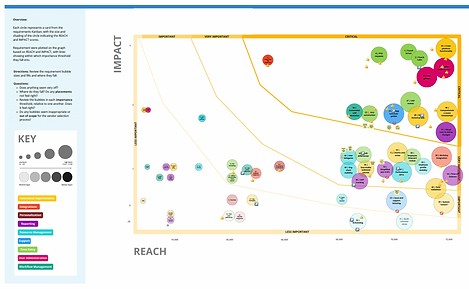
In total, 53 application level requirements were generated across the following use cases...
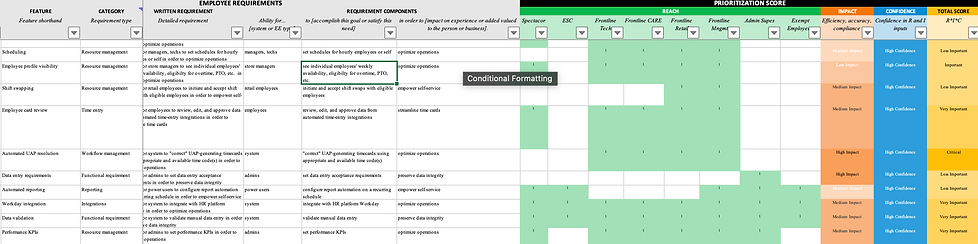
Functional Requirement, Time Entry, Resource Management, Integrations, Personalization, Support, User Administration, Reporting and Workflow Management
Organized in excel to serve as a living document, all requirements were tagged by employee group and organized into 4 tiers of priority according to a RICE model. The intention is that these requirements could be shared with vendors in the form of an RFP.
High Level Insights and Recommendations
While we were brought into to gather requirements, our high level insights emphasized the importance of understanding the people and processes involved in implementation. Sharing these stories opened our client's eyes to higher level considerations that were critical to the success of a new tool.


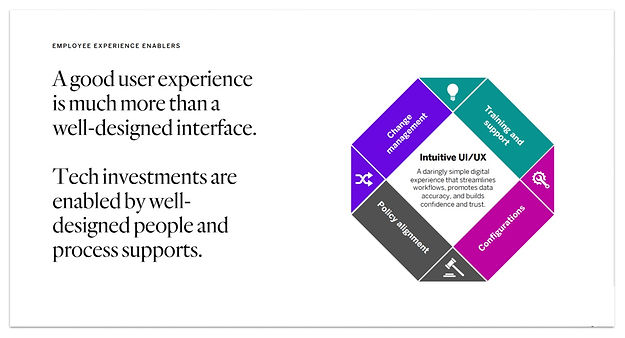
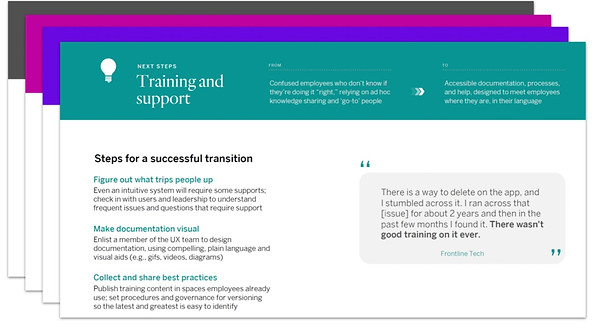
Each insight was tagged with relevant big picture needs that should be considered.
So What?
Coming from experiences like a paycheck cut short by an error during the holidays, or manual time tracking because it was faster than logging in, our client's real challenge was rebuilding trust in their time tracking tools.
By recommending focus groups and wide scopes of engagement, our workshops were one of the first times employees felt heard and had hope for changes to come. Seeing these reactions first hand, helped our client team realize the importance of change management. They began to understand that no matter how good improvements to their tool were, trust would be built by communicating changes well, quickly responding to problems and bringing users to iteratively advise the tool transition.
I think this is the first time we've been brought together in a group to actually provide feedback on the tool we're using today, and what we wanna see tomorrow.
It's nice to understand and believe that the organization is really thinking about how we're going to be doing things in the future.
"
"
-HR Professional
